Category Archives: Looking into something

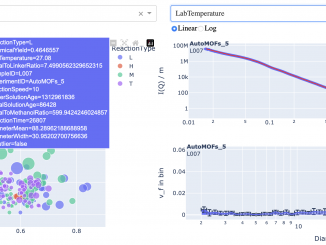
Movie: Monte-carlo fitting of anisotropic scattering

I have worked on monte-carlo procedures for a while now. Initially (while working for Aarhus University), I managed to make these work to extract the particle size distribution from isotropic scattering patterns, and it works fine and quick. Now though, I managed to get this trial-and-error procedure to work for whole 2D pattens as well! [...]

Share

Nothing new here

So it seems science has beaten us to the punch once again. Remember last week’s optimistic story on how you can make better use of your (measurement) time? Turns out it has been done (at least once) before. The year was 1993, the authors were M. Steinhart and J. Pleštil, and they did the same [...]

Share

Making better use of your time: optimizing measurement time

Often, especially when measuring on big facilities, you are given a limited amount of time. So when it comes to measuring the sample and the background, this limited time has to be divided between a measurement of the sample, and a measurement of the background. Normally, one would spend about 50% of the time on [...]

Share

Data processing flowchart and news on an old publication

Short news first; by going through the motions and waiting for Elsevier to get back to me, I have gotten permission (for the royal sum of 0.00 eurodollars) to repost one more paper from Polymer on my site. So that has now gone in the 2010 publications page here. Then it is time to give [...]

Share

New video online- presenting observability

Dear readers, First of all, a merry end-of-year thingie (insert name here) to all of you. Last week, I presented a short 15-minute talk at the MRS-J conference in Yokohama. While it was a nice opportunity to present and meet people, it is a relatively small conference. With that in mind, I decided to re-record [...]

Share

Detail-preserving 2D binning, part 1: the appetizer

(Sorry about the hiatus, there’s been a period filled with that noblest of Japanese traditions: paperwork!) If you want to do fitting of a 2D image, you want to preserve the information in the entire image. 2D fitting is quite computationally intensive, so you still want to reduce the number of pixels in your images. [...]

Share

Everybody hates statistics…

Everybody hates statistics [1]…   … but it can be of major importance in our small angle world. While very few papers on small-angle scattering discuss statistics, they can tell you whether your observations are real or just imaginary. In addition, statistics will let you know whether you have been able to describe your scattering [...]

Share

Revisiting observability in polydisperse systems: “real” polydispersity

edited on 2011-07-20 14:51 to add equation defining observability Of course I could not leave you hanging after the last post with that question “does the observability still scale with the radius squared for samples with more than two particles?”. Short answer: yes. Long answer: mostly, with some interesting lessons w.r.t. q-angles and limitations. Click [...]

Share

Observability in polydisperse systems. What is all the accuracy for?

Abstract of this post: In this post, I will show that for a spherical two-particle system, the observability of the smaller particle scales with the inverse squared radius, quite different from the scattering power, which scales with the radius to the sixth power (volume squared). This means that scattering data with 1% error can be [...]

Share

Does it matter part 2: polarization factor and spherical corrections

In this series of posts, we take a quick look at some uncommon corrections you can do to your scattering patterns and we evaluate whether they are worththe trouble or not. The goal is to arrive at intensities which are within 1% of their correct values. In the previous post, we looked at the sample [...]

Share